
Property for Sale in Madeira: Areas and Prices 2026
Where to buy on Madeira: Funchal, Camara de Lobos, Calheta, Ponta do Sol and the airport side, with buying costs and what a hillside house costs to hold.
By Portuguese Estate Editorial · Updated September 7, 2026 · 12 min read
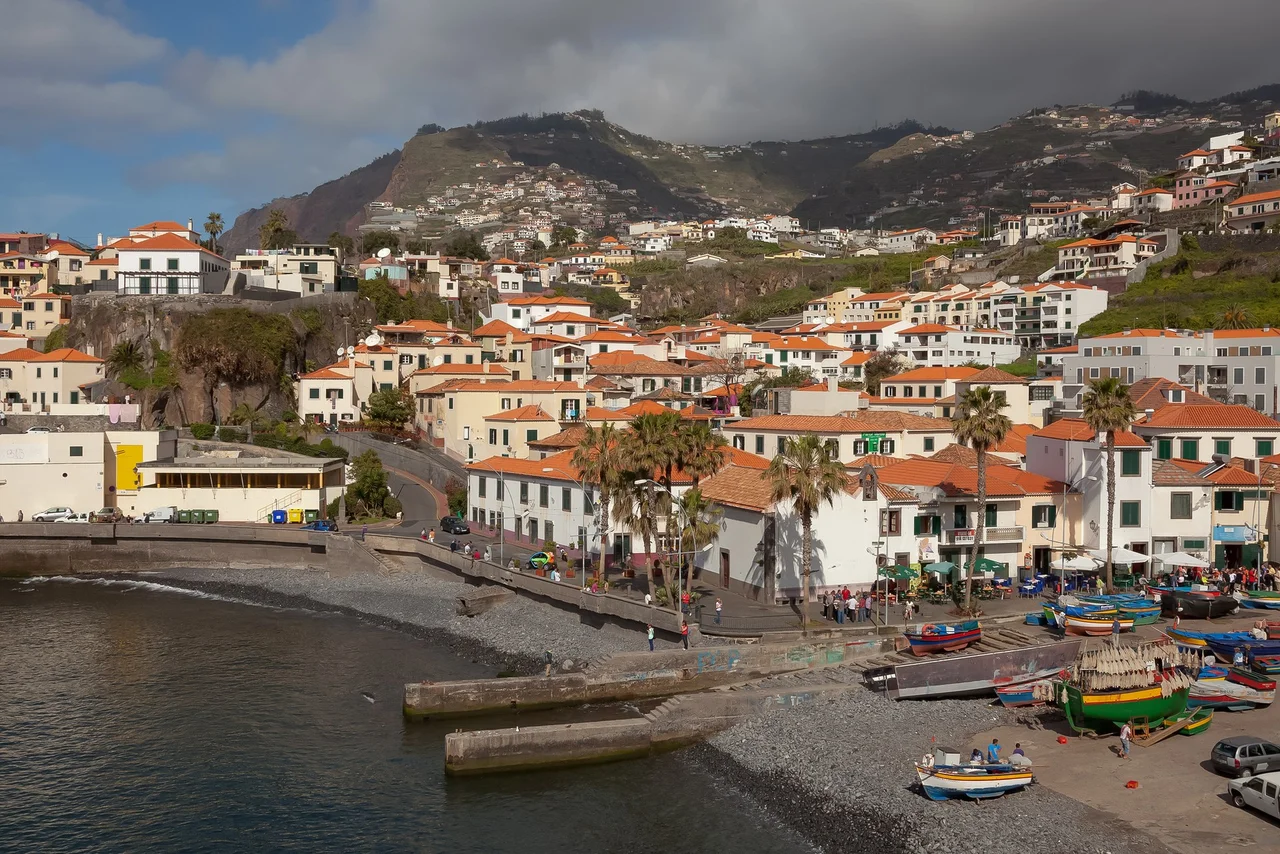
Quick Answer: Madeira is a steep volcanic island where the side of the mountain and the altitude matter more than the town. The south coast is sunny and where the market is, the north is wetter and cheaper, and almost every house sits on a slope with the maintenance that implies.
British and American buyers arrive at Madeira from different phrases. madeira property for sale runs at 720 a month in the UK and madeira portugal real estate at 590 in the United States, with property for sale in madeira adding another 590 in the UK. It is one of the few Portuguese markets where both vocabularies carry real volume.
What neither phrase tells you is the thing that decides everything here: which side of the mountain, and how high up.
The Island in Five Markets
| Area | Character | Weather |
|---|---|---|
| Funchal | The capital: hospital, schools, marina, the widest choice and the highest prices | Sunny south, sheltered bay |
| Camara de Lobos and west | A working harbour town minutes from Funchal, terraced hillside | As Funchal, slightly wetter inland |
| Calheta and Ponta do Sol | The sunny south-west, more space, the digital nomad village | The driest and sunniest on the island |
| Santa Cruz and Machico | Airport side, east, practical and better value | Sunny, windier near the airport |
| North coast and interior | Sao Vicente, Porto Moniz, Santana: dramatic and cheap | Wet, green, cloud at altitude |
Two variables cut across that table and matter more than the town name.
The side. A mountain spine runs the length of the island and splits the weather in two. The south is Mediterranean in feel, the north is Atlantic and green. They are twenty minutes apart by tunnel and completely different places to live.
The altitude. A house 400 metres above Funchal can sit inside cloud on a day when the seafront is in full sun. Buyers viewing in July often do not see this at all. Ask what the property does in a typical January, and ask someone who was there.
What It Costs
| Sub-market | Price level, island average = 100 | Note |
|---|---|---|
| Funchal, sea view and Lido | Well above 100 | The scarce combination: view, level access, services |
| Funchal, uphill parishes | Around 100 | View, at the cost of gradient |
| Camara de Lobos | Below 100 | Same access to Funchal, lower prices |
| Calheta and Ponta do Sol | Around 100 | Sun and space price in |
| Santa Cruz and Machico | Below 100 | Airport-side practicality |
| North coast and interior | Well below 100 | Weather and distance |
Take absolutes from the INE series with a date, as set out in Portugal house prices. Madeira’s constraint is buildable land: the island is small, steep and largely protected, so level plots with services and a view are genuinely scarce and priced accordingly.
What You Pay on Top
| Cost | Basis | On a EUR 400,000 house |
|---|---|---|
| IMT, non-resident | Flat 7.5% from 1 September 2026 | EUR 30,000 |
| Stamp duty | 0.8% | EUR 3,200 |
| Notary and registry | Fixed and variable | Low four figures |
| Legal fees | Commonly 1% to 1.5% | EUR 4,000 to EUR 6,000 |
| Total | Roughly 9% to 11% | About EUR 38,000 to EUR 44,000 |
Madeira is an autonomous region with its own legislative assembly, and some matters are set regionally rather than nationally. The national purchase taxes apply, but ask your lawyer to confirm the current regional position on anything that touches licensing or letting rather than assuming the mainland answer. The national mechanics are in IMT for non-residents.
What It Costs to Hold on a Slope
| Charge | Madeira character |
|---|---|
| IMI | 0.3% to 0.45% of rateable value, set by each council |
| AIMI | Reached mainly on Funchal sea-view property |
| Condominium | Moderate in Funchal blocks, absent on standalone hillside houses |
| Retaining walls and terracing | The island-specific line, and the expensive one |
| Drainage | Heavy rain tests it annually, and failures are structural |
| Humidity | High on the north side and at altitude, which affects fabric and finishes |
The slope is the running cost that no listing mentions. Terraced sites are held up by retaining structures, access is often a private track, and both need maintenance that a flat mainland plot never generates. Before buying anything on a hillside, get the retaining walls and the drainage inspected specifically, and ask what has been repaired in the last decade.
The general framework is in Portugal property running costs.
Letting, and the Nomad Effect
Madeira runs a short-term rental market driven by year-round mild weather rather than a summer season, which is unusual in Portugal and a genuine advantage for an owner who lets. Occupancy spreads across 12 months instead of concentrating into 3, and the remote-worker population adds long-stay demand through the winter.
It also has something no other Portuguese region has: a regional initiative that established a digital nomad village at Ponta do Sol, with coworking and an organised community. That has fed a longer-stay rental market on the sunny south-west coast which behaves differently from a holiday let, with longer bookings and lower turnover.
Letting requires an Alojamento Local registration under the national framework, applied regionally. Confirm the current position for the specific address before the promissory contract. See the Alojamento Local guide, and for the visa side of the nomad market, the D8 digital nomad visa.
Porto Santo, the Other Island
Porto Santo sits 40 minutes away by air or about 2.5 hours by ferry, and has the one thing Madeira lacks: 9 kilometres of golden sand. Its property market is a fraction of Madeira’s in depth, strongly seasonal, and priced well below Funchal for comparable stock.
That single fact creates a separate second-home market, mostly bought by Madeirans and mainland Portuguese, with a summer season and a very quiet winter. Prices are below Madeira’s, the choice is narrow, and the island has a few thousand residents out of season.
Three practical points before anyone treats it as a cheaper Madeira. Services are limited, so anything medical or specialist means a flight. The winter is genuinely empty, not merely quiet. And the resale market is small enough that the exit depends on a handful of buyers a year rather than on a price.
It works as a summer house for someone already anchored on Madeira or the mainland. It works poorly as a sole base.
Building and Buying Off Plan Here
Island logistics change construction economics on Madeira in three ways at once. Materials arrive by sea with freight and lead time priced in, specialist trades come from a pool smaller than any mainland region, and steep sites need retaining and drainage engineering that a flat mainland plot never requires.
| Factor | What it means on Madeira |
|---|---|
| Build cost per square metre | Higher than the mainland for equivalent specification |
| Groundworks | Terracing, retaining and access frequently exceed expectations |
| Timelines | Longer, and weather-sensitive on the north side |
| Trades | A smaller pool, so scheduling matters more |
| Licensing | Municipal, with protected landscape adding scope questions in places |
The practical consequence is that a plot with planning is not the bargain it looks like unless the groundworks have been costed by someone who has built on that gradient. Ask for a groundworks estimate before valuing the land, not after.
Off-plan purchases carry the usual completion risk with an island-specific twist: a delayed shipment can move a schedule in a way it would not on the mainland. Check what the contract says about staged payments if the schedule slips, and check it is in the contract rather than in a conversation.
Getting There, and the Wind
Madeira’s airport is one of the most weather-sensitive in Europe. It sits on a platform above the sea on the island’s south coast, and in certain wind conditions landings are suspended and inbound flights divert to Porto Santo, Gran Canaria or back to the mainland.
| Consequence | Who it affects |
|---|---|
| Occasional diversions and delays | Every visitor, several times a year |
| Short-let guest arrivals disrupted | Owners letting to holidaymakers |
| Contractor and materials scheduling | Anyone renovating |
| Winter connectivity | Owners visiting out of season |
| Perishable and furniture delivery | Everyone furnishing a property |
None of this is a reason not to buy, and residents treat it as ordinary weather. It is a reason to build slack into any plan that assumes reliable same-day arrival, and to be cautious about a letting model that depends on tight back-to-back changeovers in winter.
Everything else about access argues the other way. Funchal has direct connections to the UK, Germany and mainland Portugal through the year rather than seasonally, which is unusual for an island market this size and is a large part of why the remote-worker population settled here rather than in the Azores.
Levadas, Water Rights and Rural Land
The levadas are the island’s irrigation channels, cut into the hillsides over centuries to move water from the wet north to the dry south. They are the reason terraced agriculture exists here at all, and they carry a legal dimension that surprises mainland and foreign buyers.
Rural land on Madeira frequently comes with an attached water right: a defined share of a levada’s flow, on a defined rota, sometimes measured in hours per week. That right is a property interest, it has value, and it can be sold, divided or lost separately from the land.
| Check | Why |
|---|---|
| Is a water right attached | Terraced land without one may be unusable for planting |
| What share, on what rota | Rights are quantified, not general |
| Is it registered | Verbal and customary arrangements are common and weak |
| Access to the channel | The right is worthless without a route to the water |
| Levada walking route | A public path across the plot changes privacy and value |
The last row cuts both ways. Levada paths are the island’s main walking network and a route across a plot brings walkers past the property daily. On a rural holding that may be a nuisance; on a property intended for tourist letting it is an amenity worth advertising.
Anyone buying terraced land here should have their lawyer confirm the water position in the registry alongside the boundaries, because on this island the two are separate questions and the second one is what makes the land productive.
Island Logistics and What They Cost
Everything on Madeira arrives by sea or air, and that shapes ownership in ways a mainland buyer does not anticipate until the first renovation quote lands. Freight, lead times and a limited trade pool affect building materials, furniture, appliances and vehicles alike, and they affect scheduling more than they affect price.
| Item | Island effect |
|---|---|
| Building materials | Shipped, so quotes carry freight and lead time |
| Furniture and appliances | Longer delivery windows, higher shipping |
| Bringing a car | Ferry or container from the mainland, plus paperwork |
| Specialist trades | A smaller pool, so scheduling is the constraint |
| Groceries and fuel | Structurally above mainland levels |
The trades point is the one that decides renovation timelines. The island has capable builders, but there are fewer of them than in Lisbon or the Algarve, and a good one is booked months out. A renovation planned around mainland assumptions about availability will slip, and the slippage is measured in seasons rather than weeks.
There is a seasonal passenger and vehicle ferry between Funchal and the mainland, which matters mainly to owners moving a household rather than to visitors. For everything else the practical answer is to plan purchases in batches, accept the lead times, and treat the delivery schedule as part of the project plan rather than a surprise inside it.
Pros and Cons
Madeira offers a year-round letting season rather than a 3-month one, direct flights to northern Europe through the winter, and an established remote-worker population. It also carries slope engineering costs, island freight on everything, and an airport whose crosswinds divert flights several times a year.
Advantages:
- Mild all year, with no real off-season for letting
- A genuine hospital, international school and airport on an island of this size
- Prices below the Lisbon metro for comparable quality
- The digital nomad village gives the south-west a year-round rental base
- Direct flights to several northern European cities
Disadvantages:
- No sandy beaches in the mainland sense
- Almost everything is on a slope, with the maintenance that implies
- Buildable land is genuinely scarce, so good sites are priced
- The north coast is wet enough to change how a house is built and kept
- Island logistics: everything arrives by sea or air, which shows in build costs
Risks and Red Flags
Madeira purchases fail on the slope and on logistics. Retaining walls, drainage and access on a steep site carry costs a flat mainland plot never generates, and a renovation planned on mainland assumptions about trade availability will slip by seasons.
- Viewing only in summer. The altitude and the side of the island are winter questions.
- A slope taken on trust. Retaining walls and drainage are structural, and their failure is expensive.
- Assuming the mainland rulebook throughout. Madeira is autonomous; confirm anything regional.
- A view priced without checking the cloud line. Altitude changes what you actually see, and how often.
- Access tracks assumed to be public. Private access on this terrain is common and needs documenting.
Checklist before you offer:
- Establish the side of the island and the altitude, and ask what January looks like there
- Commission a specific inspection of retaining structures and drainage
- Confirm the legal status of the access
- Get the current VPT and last year’s IMI for the property
- Confirm the letting position for the address with the municipality
Who Each Area Suits
Five Madeira markets means five different buyers, and the variable that separates them is not view but access. Whether a property has level entry, how far it sits from Funchal’s hospital and schools, and how steep the final approach is decide more about daily life here than any other factor.
Buyers who want services. Funchal, and specifically the parishes with level access, which cost more for exactly that reason.
Buyers optimising on price near the capital. Camara de Lobos, minutes west, with the same hospital and airport access.
Remote workers and sun-seekers. Calheta and Ponta do Sol on the south-west, where the nomad community and the driest weather both are.
Practical buyers. Santa Cruz and Machico on the airport side, where the value is and the flights are close.
Buyers who want drama and low prices. The north coast, after a winter visit rather than before one. Sao Vicente and Porto Moniz are spectacular and genuinely wet, and the houses there are built for it in a way a south-coast villa is not.
Frequently Asked Questions
Funchal for services, the hospital and the widest choice, Camara de Lobos just west for the same access at lower prices, Calheta and Ponta do Sol on the sunnier south-west for space and light, and Santa Cruz or Machico on the airport side for convenience and value. The north coast is dramatic, wetter and materially cheaper, and it suits people who have spent a winter there.
Funchal prices sit between the mainland value belt and the Lisbon metro, with sea-view property carrying a clear premium. Away from Funchal, prices fall quickly, and the north coast and the interior are among the cheaper habitable markets in Portugal. The island's constraint is buildable land rather than demand, which keeps the good sites priced.
Not in the mainland sense. The island is volcanic, so the coast is pebble, black sand and rock, with a handful of imported-sand beaches and many sea pools built into the rock. Porto Santo, the neighbouring island, has the long golden beach that Madeira does not, which is why it has its own second-home market.
A regional initiative that established Ponta do Sol as a base for remote workers, with coworking and an organised community. It is a genuine differentiator no other Portuguese region has, and it feeds a rental market on the sunny south-west coast. If you are moving on a D8 visa, it is the part of Portugal built around exactly that.
Mild year-round, and split by the mountain spine. The south coast around Funchal, Camara de Lobos and Calheta is markedly sunnier and drier; the north around Sao Vicente and Porto Moniz is wetter and greener. Altitude changes it again: a house 400 metres above Funchal sits in cloud on days when the seafront is clear. Ask which side and what altitude before anything else.
The same national charges: roughly 9% to 11% of the price as a non-resident, led by a flat 7.5% IMT on residential property from 1 September 2026 plus 0.8% stamp duty, then notary, registry and legal fees. Madeira is an autonomous region with its own government, so verify any regional variation with your lawyer rather than assuming the mainland position throughout.
More than an equivalent mainland apartment, yes. Steep sites mean retaining walls, access tracks and drainage, all of which need upkeep, and heavy rain tests them. Add humidity, which is high on the north side and at altitude. Ask specifically about the retaining structures and the drainage before you buy anything on a slope, which on Madeira is most things.
Looking at Madeira?
Tell us the budget and whether you need level access. We shortlist by side of the island and price the slope maintenance.
Get a Portugal property shortlist
Tell us your budget and region (Lisbon, Algarve, Porto, Cascais). We reply within one business day with vetted options matched to your goals.