
Property for Sale in Porto: Districts and Prices 2026
Where to buy in Porto and across the Douro: the historic centre, Boavista, Foz, Matosinhos and Vila Nova de Gaia, with buying and holding costs.
By Portuguese Estate Editorial · Updated September 7, 2026 · 12 min read
Quick Answer: Porto gives you most of what Lisbon gives at a clearly lower price, and charges you a colder, wetter winter in housing stock that was rarely built to handle one. The district decision runs from the historic centre through Boavista and Foz to Gaia across the river and Matosinhos up the coast.
American search behaviour puts porto portugal real estate at 880 a month and porto real estate at 720, while British buyers search porto property for sale at 590 and property for sale in porto portugal at another 590. Two vocabularies, the same question, and the same answer: which part.
Porto is smaller and more legible than Lisbon, which makes the district choice easier and the consequences of getting it wrong smaller. It is also wetter, and that shows up on the electricity bill rather than in the listing.
The gap to Lisbon is the reason most buyers end up here, and it is worth stating precisely. Porto has been closing on the capital since 2015 without catching it, so the discount is smaller than a decade-old guide suggests and still large enough to change what a given budget buys: typically more floor area, a newer building, or a better address, and often two of the three.
The Five Porto Markets
| Market | Where | Character |
|---|---|---|
| Historic centre | Ribeira, Se, Vitoria, Bolhao | UNESCO fabric, oldest buildings, tightest constraints |
| Central residential | Boavista, Cedofeita, Bonfim, Paranhos | Lift-served blocks, schools, metro, how the city lives |
| Coast | Foz do Douro, Nevogilde | The top of the Porto market, sea and river frontage |
| Across the river | Vila Nova de Gaia | Separate municipality, river views back at Porto, lower prices |
| Up the coast | Matosinhos, Leca | Beach, metro, working port, modern stock at a discount |
District by District
Ribeira and the historic core. The postcard Porto, and the most constrained. Buildings are old and often narrow, streets are steep, parking is close to theoretical, and works in the protected zone come with a scope the municipality decides rather than the owner. The most beautiful option and the least practical.
Boavista and Cedofeita. Where Porto residents actually buy. Lift-served apartment blocks, the Casa da Musica, schools, shops and metro, at prices below Foz and above Gaia. The default answer for someone moving to the city rather than visiting it.
Foz do Douro. Where the Douro meets the Atlantic, and the top of the local market. Larger apartments, some houses, a promenade, and the highest prices per square metre in the north. Quieter and more residential than its price suggests.
Vila Nova de Gaia. Across the river and a different municipality, which is a practical point rather than a technicality: IMI is set per council, so the annual charge on a comparable property differs. You get the view of Porto rather than the view from it, the port lodges, and a riverfront that has improved steadily. Prices sit below the Porto bank for the equivalent property.
Matosinhos and Leca. North along the coast, on the metro, with a beach, a working fishing harbour and more modern housing than the centre. It reads as a suburb, which is why it costs less than Foz for comparable proximity to the sea.
Old Stock or New
Porto’s supply divides much as Lisbon’s does, but the winter makes the choice sharper. An unimproved granite building with single glazing is genuinely cold from November to March, so the premium on properly renovated stock here reflects comfort rather than finish, and the discount on a project reflects real work.
| Stock | What you get | What it costs you |
|---|---|---|
| Unrenovated historic | The lowest price per square metre in the centre | A licensed works project, and in the UNESCO zone a scope the council sets |
| Renovated historic | Period fabric with modern services | A premium, and a condominium that still owns an old facade |
| Purpose-built modern | Lifts, parking, insulation, predictable charges | Boavista, Gaia and Matosinhos rather than the core |
The insulation difference is worth more in Porto than anywhere else in Portugal. An uninsulated apartment in a wet northern winter costs real money to keep dry and warm, and damp damage compounds if it is not. A modern building to current standards changes that outcome, which is a large part of what the premium buys.
The renovation route is popular here because the raw stock is cheap and the results can be excellent. Price it properly: the works, the obras licence, the queue, and in the protected zone the fact that what you may do is decided by the municipality rather than the architect.
What It Costs to Buy
| Cost | Basis | On a EUR 350,000 apartment |
|---|---|---|
| IMT, non-resident | Flat 7.5% from 1 September 2026 | EUR 26,250 |
| Stamp duty | 0.8% | EUR 2,800 |
| Notary and registry | Fixed and variable | Low four figures |
| Legal fees | Commonly 1% to 1.5% | EUR 3,500 to EUR 5,250 |
| Total | Roughly 9% to 11% | About EUR 33,000 to EUR 39,000 |
A Portuguese tax resident buying the same apartment moves onto a progressive scale that starts far lower, and a buyer who becomes resident within 24 months can reclaim the excess. See IMT for non-residents and the full cost of buying.
Take absolute prices per square metre by parish from the INE series with a date, as set out in Portugal house prices. Porto and Gaia are different municipalities and should be compared as such rather than lumped together.
What It Costs to Hold
| Charge | Porto character |
|---|---|
| IMI | 0.3% to 0.45% of rateable value, and Porto and Gaia set their own rates |
| AIMI | 0.7% above EUR 600,000 of taxable value per owner, reached mainly in Foz |
| Condominium | Heaviest on old central buildings with facades and retrofitted lifts |
| Heating | The line that separates Porto from the south, on uninsulated stock |
| Damp maintenance | Higher than Lisbon or the Algarve, especially on north-facing older stock |
The heating and damp lines are not decoration. Porto’s winter is genuinely wet, older buildings were not built against it, and the annual cost of keeping an uninsulated apartment dry and warm is a number worth asking a current owner for rather than estimating. Running costs are covered in Portugal property running costs.
Letting It Out
Porto operates its own Alojamento Local framework and it is not Lisbon’s. Restrictions are geographic, apply parish by parish across Ribeira, the UNESCO core and the riverside, and change over time. Existing licences do not transfer on sale. The only usable answer is the current municipal position for the specific address, obtained before the promissory contract.
If an existing registration is being sold as part of the value, get written confirmation of whether it transfers in that municipality and a price mechanism if it does not. The detail is in Porto Alojamento Local rules.
Long-term letting is the steadier option here. Porto has a real student and young-professional population, which supports a rental market that does not depend on the licensing map.
The Student Market Underneath Everything
Porto has one of the largest student populations in the country, spread across the University of Porto, the polytechnic and several private institutions, and that population sets the floor under the city’s rental market in a way visitors never see.
| Feature | What it means for an owner |
|---|---|
| Academic year | Demand concentrates in September, empties in July |
| Location that matters | Paranhos, Asprela, Campo Alegre, not Ribeira |
| Unit type | Rooms and small flats, not two-bedroom apartments |
| Yield | Higher per square metre than family letting |
| Wear | Higher, and turnover is annual by definition |
| Regulation | Room letting has its own tax and contract treatment |
The practical point is that the student market and the tourist market want opposite properties in opposite places. A restored Ribeira apartment is a short-let asset with no student demand at all; a plain flat in Paranhos near the Asprela campus is the reverse. Buying in one market and underwriting with the other’s numbers is a common and expensive error.
It also explains a Porto pattern that confuses newcomers: unremarkable buildings in unremarkable northern parishes trading at yields the historic centre cannot match. The building is not the asset there. The walk to the faculty is.
Granite, Damp and Which Way the Rooms Face
Porto is built in granite and it rains for much of the winter. Those two facts drive more renovation cost here than any design decision, and both are invisible in summer photographs. Rising damp, thermal mass and single glazing together account for the largest line in most Porto renovation budgets.
| Issue | Where it shows | What it costs |
|---|---|---|
| Rising damp | Ground and first floors of old stock | Injection, tanking, replastering |
| Granite thermal mass | Everywhere in the old city | Slow to heat, cold through winter |
| North-facing rooms | Narrow streets in the historic core | Little direct sun for months |
| Single glazing | Most unrenovated stock | Noise and heat loss together |
| Roof and gutters | Old buildings on steep sites | Water finds the cheapest path down |
Porto’s winters are wetter and cooler than the Algarve’s, and a granite building with no insulation and single glazing is genuinely uncomfortable from November to March. That is why properly renovated stock carries the premium it does here, and why an unrenovated bargain in the Se or Miragaia is a project rather than a discount.
Orientation deserves its own viewing. In the narrow streets of the historic core, an apartment two floors up can see almost no direct sun between November and February, while the same building’s top floor sees it all day. Ask which way the rooms face and visit in the afternoon, and treat any viewing arranged only for a bright morning with appropriate suspicion.
Crossing the River Is a Municipal Border
Vila Nova de Gaia faces Porto across the Douro and is a separate municipality rather than a district of the city. The distinction is invisible from the far bank and appears in every document: Gaia sets its own IMI rate within the national 0.3% to 0.45% band, runs its own licensing queue, and takes its own position on short lets.
| Porto | Vila Nova de Gaia | |
|---|---|---|
| Municipality | Porto | Gaia, its own council |
| IMI rate | Set by Porto | Set by Gaia, and can differ |
| Short-let policy | Porto’s containment map | Gaia’s own rules and map |
| Building licences | Porto’s queue | Gaia’s queue |
| Price level | Higher for equivalent stock | Lower, with the same view back |
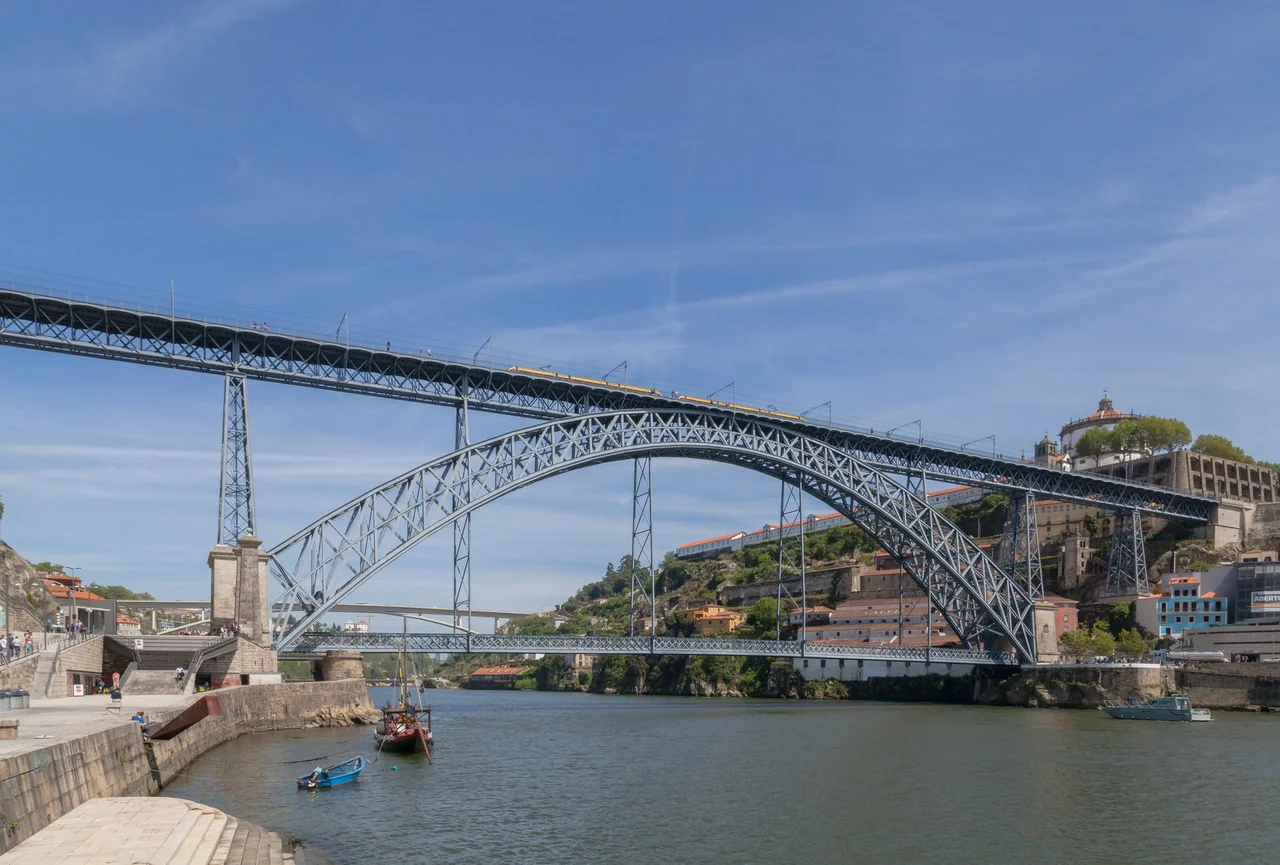
| Metro | Yellow line crosses the Luis I bridge | Same line, southern stations |
The riverfront strip in Gaia, with the port lodges and the view of Ribeira, prices closer to Porto than the rest of the municipality does, because what buyers are paying for is the view of the other bank. Move a few hundred metres inland and the discount is substantial for stock that is functionally identical.
For a resident the crossing is trivial: the metro runs over the upper deck of the Luis I bridge and the walk across is one of the pleasures of living here. For a buyer the point is administrative. Confirm which council governs the property before assuming anything about its letting position or its annual tax, because the answer is not the one the postcard implies.
Pros and Cons
Porto offers materially lower entry prices than Lisbon for comparable stock, a rental floor set by tens of thousands of students, and a compact centre that works without a car. It also carries a wetter, colder winter, a granite building stock that is expensive to make comfortable, and a shallower foreign resale market.
Advantages:
- Materially below Lisbon for comparable space and quality
- A genuine city economy rather than a resort one, with year-round demand
- Metro, trains and a compact centre make much of it walkable
- A growing international community without Lisbon’s saturation
- Gaia and Matosinhos widen the choice at lower prices
Disadvantages:
- Colder and much wetter winters than the south
- Older stock is poorly insulated and expensive to keep dry
- The historic core is steep, narrow and hard to park in
- A smaller international job market than Lisbon
- Fewer long-haul flights, so international travel routes via Lisbon or Madrid
Risks and Red Flags
Porto purchases fail on damp and on the licence. Granite, rain and single glazing together make an unimproved building genuinely cold from November to March, and the Alojamento Local position is parish by parish and does not transfer on sale.
- Summer viewing only. The winter is the variable in Porto, and February settles it.
- Assuming a letting licence. Porto’s rules are its own, geographic, and current.
- Comparing Porto and Gaia as one market. Different councils, different IMI, different prices.
- Protected-zone works assumed. In the UNESCO area the permitted scope is the municipality’s call.
- A retrofitted lift taken on trust. Ask what the condominium has actually approved and funded.
Checklist before you offer:
- Registered comparable sales in the same parish, in the same municipality
- Current VPT and last year’s IMI for the specific property
- Two years of condominium accounts and any approved but unbilled works
- The municipal AL position for the address, in writing
- What the current owner actually paid to heat it last winter
The Douro Valley Behind the City
Porto is the gateway to the Douro, and a small but persistent share of buyers arrive looking for the valley rather than the city. The drive to Peso da Regua takes roughly 90 minutes, and the property involved is a quinta with terraces, planting rights and a maintenance liability rather than an apartment.
Two things are worth knowing before that search starts. Quintas with working vineyards are agricultural businesses with agricultural obligations, not large houses with a view, and the diligence is different: water rights, planting rights, access tracks and existing labour arrangements all matter. And the valley is an hour and a half to two hours from Porto on roads that are slow in winter, which changes what a weekend house means.
The valley also has very little transactional depth. Comparable registered sales are scarce, which makes pricing an art and the exit slow. That is not an argument against buying there, it is an argument for a longer holding period and a wider margin than a city purchase needs.
Who Each Area Suits
Five Porto markets means five different buyers, and the variables that separate them are the winter, the river and the university. Whether you need a lift and a dry building, whether you want the water or the beach, and whether your tenant is a student or a family all point to different parishes.
People moving to the city. Boavista, Cedofeita or Bonfim: lifts, schools, metro and daily life that works in the rain.
Buyers who want the coast. Foz for the top of the market, Matosinhos for the same sea at a lower price with the metro.
Buyers optimising on price. Vila Nova de Gaia, with the view back at Porto and a different council’s IMI rate.
Buyers who want the historic city. Ribeira and the Se, accepting the steps, the parking, the works scope and the letting restrictions. Worth walking the specific street with luggage before deciding, because the gradient does not show on a listing photograph.
Buyers letting long-term. Paranhos, Bonfim and the university side, where the student and young-professional pool is deepest and the licensing map is irrelevant.
The wider market analysis, including yields and history, is in the Porto property guide, and the north-versus-capital comparison in Porto versus Lisbon.
Frequently Asked Questions
Yes, and clearly so, although the gap is narrower than it was in 2015. Porto has been closing on Lisbon for a decade while remaining materially below it on both rent and purchase price per square metre. For the same money a buyer typically gets more floor area, a newer building, or a better address, and sometimes all three.
The historic centre for period fabric and the strictest constraints, Boavista and Cedofeita for the city as residents live it, Foz for the coast and the top of the market, and across the river in Vila Nova de Gaia for river views at lower prices. Matosinhos to the north gives you the beach, the metro and the fish market at a discount to Foz.
Porto operates its own Alojamento Local framework with restrictions that differ from Lisbon's, and they are geographic. Check the current municipal position for the specific address before the promissory contract. Buying a central apartment on projected holiday-let income without confirming the licensing position is the most expensive assumption in this market.
It is a separate municipality across the Douro, which matters because IMI is set per council. You get the classic view back at Porto rather than being in it, port lodges and a riverfront that has been steadily upgraded, and prices below the equivalent on the Porto bank. The metro and the bridges make it a short trip into the city.
For beach access at a discount to Foz, yes. It has the metro into central Porto, a working fishing port and the best casual seafood in the region, and its housing is more modern and less constrained than the historic centre. It reads as a suburb rather than a destination, which is exactly why it is cheaper.
Roughly 9% to 11% of the price as a non-resident: a flat 7.5% IMT on residential property from 1 September 2026, 0.8% stamp duty, plus notary, registry and legal fees. Older central buildings then carry heavier maintenance and condominium charges than the modern stock, which is the running cost most often underestimated.
Colder and considerably wetter than Lisbon or the Algarve, and that matters because much of the older housing stock was built without insulation. Heating an uninsulated Porto apartment from December to February is a real annual cost that falls on the owner. It is the single most common surprise for buyers who visited in summer.
Comparing Porto districts, or Porto against Lisbon?
Tell us the budget and what the home is for. We shortlist by district and show the real cost of holding each.
Get a Portugal property shortlist
Tell us your budget and region (Lisbon, Algarve, Porto, Cascais). We reply within one business day with vetted options matched to your goals.