
Property for Sale in Faro and Olhao: Areas and Prices
Where to buy in Faro: the walled old town, Montenegro, Gambelas and the island beach, with why the Algarve capital prices below the resorts it serves.
By Portuguese Estate Editorial · Updated September 7, 2026 · 15 min read
Quick Answer: Faro is the Algarve’s only real city, and it prices as one: below the resorts it serves, with local tenants, year-round services and no season. Most foreign buyers fly through it and never look, which is precisely the opportunity.
American searches put faro portugal real estate at 170 a month and British buyers add property for sale in faro portugal at 260. Those are modest numbers next to Albufeira’s 590, and the gap is instructive: Faro handles millions of arrivals a year and almost none of them consider living there.
That is the market. Faro is a functioning Portuguese city of around sixty thousand people that happens to have an international airport attached, and it is priced as a provincial capital rather than as an Algarve address.
The Five Faro Markets
| Area | What it is | Character | Typical stock |
|---|---|---|---|
| Cidade Velha, the walled old town | Cathedral, bishop’s palace, cobbled lanes inside the walls | Protected, scarce, no parking | A handful of houses |
| Baixa and the marina | The pedestrian shopping streets and the harbour front | Walkable city living | Apartments, some townhouses |
| Montenegro and Gambelas | Toward the airport and the university | Family housing with parking | Houses, modern apartments |
| Northern districts, Penha and beyond | Residential Faro, away from the water | Ordinary, local, cheapest | Apartment blocks, townhouses |
| Praia de Faro | The barrier island beach, over the bridge | Constrained, park territory | A specialist market |
Area by Area
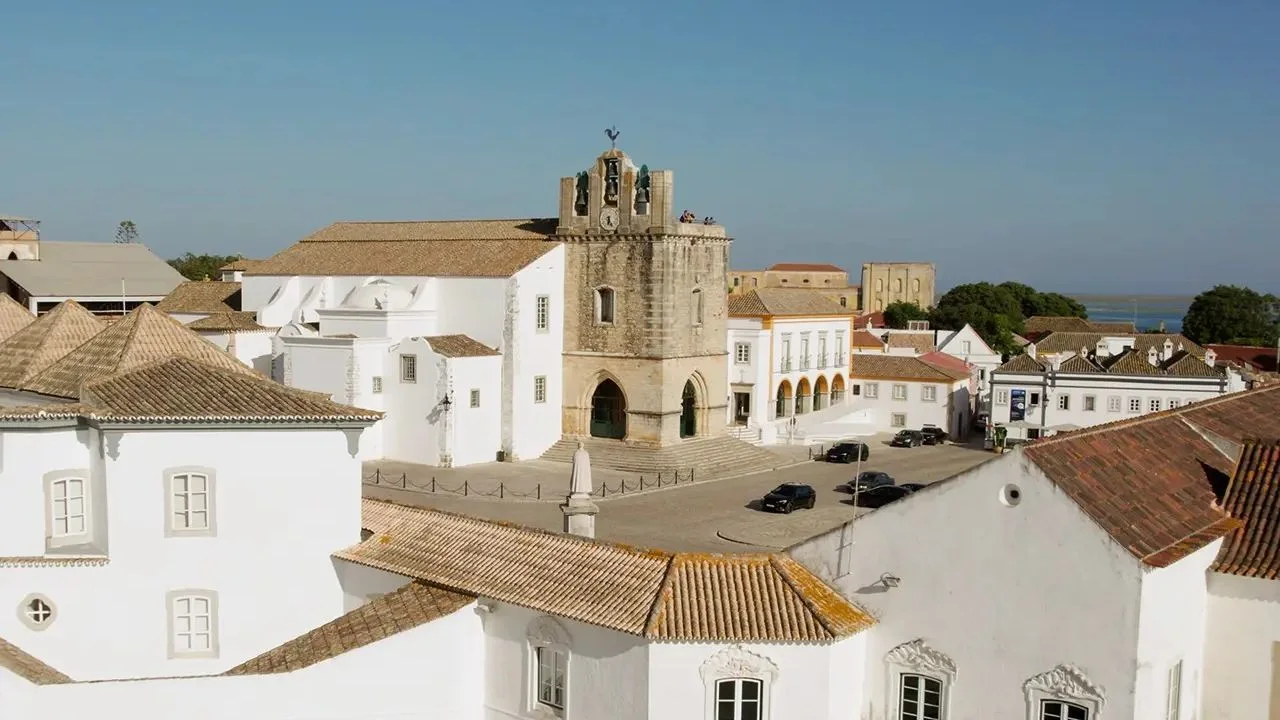
Cidade Velha. Inside the medieval walls, entered through the Arco da Vila with its storks, sits a small quarter of cobbled lanes around the cathedral and the old bishop’s palace. It is beautiful, it is tiny, and very little of it comes to market. What does is protected: facades, windows and rooflines are the municipality’s decision, and parking inside the walls is effectively nonexistent.
The Baixa and the marina. North of the walls, the pedestrian shopping streets run up from the harbour, with apartment blocks above the shops and the marina and the Ria Formosa in front. This is where walkable city living is: cafes, the market, the theatre, the ferry to the islands. Apartments here range from unmodernised stock in older buildings to renovated flats with lifts.
Montenegro and Gambelas. West toward the airport and the university campus, this is family Faro: houses with garages, modern apartment blocks, schools and supermarkets. Prices are below the centre and the practical quality of life for a household with children is higher. Montenegro sits close to the airport, which is a real consideration in summer.
The northern districts. Behind the centre, ordinary residential Faro, where local people live and where prices are lowest. No sea, no old town, and a functioning neighbourhood.
Praia de Faro. The city’s beach sits on a barrier island of the Ria Formosa, reached by a bridge and a narrow road, with the ocean on one side and the lagoon on the other. It is genuinely a beach and genuinely a complicated place to own: the island lies inside the natural park, building is tightly controlled, and there is a long history of contested and demolished structures. Anyone considering it should treat the licensing history of the specific building as the first question rather than the last.
What Each Area Costs
| Sub-market | Level, Faro = 100 | What drives it |
|---|---|---|
| Cidade Velha | Well above 100 | Scarcity and character, despite the constraints |
| Marina front and Baixa, renovated | Above 100 | Walkability and the water |
| Praia de Faro | Above 100, and volatile | Beach frontage against real regulatory risk |
| Montenegro and Gambelas | Around 100 | Family housing with parking |
| Baixa, unmodernised | Below 100 | Before works and the licensing queue |
| Northern districts | Well below 100 | Ordinary residential, no premium |
Take absolutes from the INE series with a date, as set out in Portugal house prices. Faro is one of the few Algarve municipalities where the INE figure is genuinely representative, because the market is a normal urban one rather than a blend of resort products.
Why Faro Prices Below the Resorts
Faro prices below the resort coast for one reason: it is a working city rather than a holiday destination, so its property competes for residents rather than for holidaymakers. Local incomes and local mortgage capacity set the floor, and no beachfront premium sits on top of it.
| Factor | Effect on price |
|---|---|
| No holiday premium | Buyers are local households, not second-home purchasers |
| A working economy | Demand comes from employment, not from sunshine |
| The beach is offshore | No beachfront residential stock in the conventional sense |
| An airport in the city | Convenient, and a noise cost in some districts |
| Perceived as somewhere to pass through | Foreign demand is thin, which suppresses the premium |
The consequence for a buyer is straightforward: the same specification costs less here than in Albufeira, Carvoeiro or Vilamoura, and comes with services those places do not have. What you give up is the resort setting and the letting rates that go with it.
Both Rental Markets Work Here
Faro is one of very few Algarve towns where both letting markets work. A resident population, a hospital, a university and year-round employment sustain 12-month tenancies at a flat 28% non-resident tax on net income, while the airport 8 minutes away supports short lets where the licence allows.
| Market | Tenant pool | Character |
|---|---|---|
| Long-term | Students, hospital and airport staff, public employees, university faculty | Year-round, steady, unaffected by the licensing map |
| Short-term | Visitors using the city, the old town and the islands | Works in the centre, subject to the municipal position |
For an owner whose plan is income rather than personal use, that combination is worth more than a higher peak rate in a resort. A long let in Faro produces twelve months of occupancy with one changeover; a resort apartment produces eight strong weeks, a scatter of shoulder bookings and a winter of nothing, plus management, cleaning and turnover costs on every stay.
The licensing authority for short-term letting is Faro municipality, and the position should be confirmed for the specific address before the promissory contract. See the Alojamento Local guide and the net arithmetic in the Portugal rental yield guide.
What You Pay to Buy
| Cost | Basis | On a EUR 250,000 apartment |
|---|---|---|
| IMT, non-resident | Flat 7.5% on residential property from 1 September 2026 | EUR 18,750 |
| Stamp duty | 0.8% of price | EUR 2,000 |
| Notary and land registry | Fixed and variable | Low four figures |
| Legal fees | Commonly 1% to 1.5% | EUR 2,500 to EUR 3,750 |
| Total acquisition | Roughly 10% to 12% at this price level | About EUR 25,000 to EUR 28,000 |
Note the proportion. Notary, registry and legal fees have a floor, so at Faro price levels they take a larger share of the budget than they would on a resort purchase. See IMT for non-residents and the full cost of buying.
Buyers relocating rather than buying a second home should note the timing point: buying after establishing Portuguese tax residency puts you on the resident scale instead of the flat 7.5%, and at these prices that difference is a meaningful share of a year’s living costs.
What It Costs to Hold
| Charge | Faro character |
|---|---|
| IMI | 0.3% to 0.45% of rateable value, at Faro’s rate |
| AIMI | Effectively never reached outside the very top of the market |
| Condominium | Moderate: city blocks rather than resort developments with pools |
| Maintenance | Older centre stock carries facade and damp obligations |
| Salt air | Present near the water, mild compared with an exposed clifftop |
Condominium charges are one of Faro’s quiet advantages. A city apartment block with a lift and a stairwell costs a fraction of what a resort development with pools, gardens and security costs to run, and that difference compounds every year of ownership. See Portugal property running costs.
The Airport, Both Ways
| Aspect | Effect |
|---|---|
| Convenience | The shortest transfer in the Algarve: minutes, not an hour |
| Noise, Montenegro and Praia de Faro | Real, and concentrated in the summer schedule |
| Noise, old town and northern districts | Much less, and often negligible |
| Employment | A significant local employer, which supports the rental market |
| Letting demand | Airport staff and short-stay visitors both use the city |
The honest instruction is to visit the specific address at a busy hour in summer rather than judging from a map. Approach paths concentrate the effect on particular districts, and the difference between two streets a kilometre apart can be substantial.
The Ria Formosa on the Doorstep
Faro sits on the edge of the Ria Formosa, a lagoon and barrier-island system that is a natural park and one of the most important wetlands in Europe. For a resident it is a daily amenity rather than a distant designation.
| Island | Access from Faro | Character |
|---|---|---|
| Ilha Deserta, Barreta | Ferry from the city harbour | Uninhabited, one restaurant, long empty sand |
| Ilha da Culatra | Ferry | A working fishing community, no cars |
| Ilha do Farol | Ferry | A lighthouse, houses, a beach on the ocean side |
| Praia de Faro, Ancao | Road bridge, or ferry | The city beach, and the constrained one |
Two implications for a buyer. The ferries leave from the city itself, which means an apartment in the Baixa is genuinely twenty minutes from an empty beach without owning a car. And the park designation caps development across the whole lagoon front, so the outlook from the marina and the waterfront is protected in a way that a resort seafront is not.
The counterpart is that owning on the islands themselves is a different and far more constrained proposition than owning in the city that looks at them, and the two should not be confused.
Olhao, Eight Kilometres East
The obvious comparison for a Faro buyer is Olhao rather than Albufeira or Lagos. It sits 8 kilometres east along the same lagoon, at a similar budget, and offers a genuinely different market: a working fishing port with flat-roofed cube houses and a renovation-driven buyer set.
Olhao is a working fishing port, the largest on the Algarve, and it does not read as a resort at all. Its old quarters, the Barreta and the Levante, are built in flat-roofed cube houses with roof terraces, an architecture unlike anything else in the region and the reason the town has drawn a renovation-driven buyer set since the mid-2010s. The market square markets on the waterfront are the daily centre of the town rather than a visitor attraction.
| Faro | Olhao | |
|---|---|---|
| Character | A small administrative city | A working fishing port |
| Housing stock | Pombaline centre, 1970s blocks, suburbs | Cube houses with roof terraces, plus newer blocks |
| Renovation market | Active in the Baixa | The defining feature of the town |
| Ferries to the islands | From the city harbour | From the town quay, to Armona and Culatra |
| Airport | About 8 minutes | About 20 minutes |
| Price level | Below the resort coast | Below Faro in the older quarters |
| Foreign share | Modest | Higher, concentrated in the renovated stock |
Three things a buyer should know before treating the two as interchangeable. The roof terrace is the amenity that carries the price in the old town, so a house without one, or without the structure to add one, sits in a different bracket. The lanes in the Barreta and Levante are narrow enough that parking is a real constraint and a genuine price factor. And renovation is licensed by Olhao’s own municipality, not Faro’s, with its own queue and its own rules in the protected quarters.
The letting picture also differs. Olhao has no beach of its own, the sand is on Armona and Culatra across the water, which shortens the peak season relative to the resort coast but leaves the town busy year-round on its own economy. Anyone underwriting a purchase there on Albufeira occupancy assumptions is underwriting the wrong town.
Renovating in the Centre
A large share of Faro’s Baixa stock reaches the market needing work, and the binding constraints are municipal rather than technical. The walled centre is protected, so facades, roof lines, window openings and materials are controlled, and an obras licence runs on the council’s timetable rather than the builder’s.
| Element | Position in central Faro |
|---|---|
| Permitted scope | Narrower inside the protected zone, particularly on facades and rooflines |
| Obras licence | Required for structural work and anything touching the envelope, with a queue |
| Lifts | Frequently absent, and retrofitting is a condominium decision, not an owner’s |
| Damp | Traditional construction near a lagoon; ventilation is the fix, not paint |
| Tax effect | Documented, invoiced works reduce the taxable gain on eventual sale |
The lift question decides more purchases here than buyers expect. A third-floor flat without one is a different asset from the same flat with one, both to live in and to let, and adding a lift is a project for the whole building rather than a decision one owner can take.
Get a written indication of permitted scope from the camara before the offer, and price the licence queue into any plan that depends on a completion date.
What Faro costs against the resort coast
Take a EUR 200,000 two-bedroom apartment behind the Baixa. Acquisition for a non-resident is 7.5% IMT of EUR 15,000 plus 0.8% stamp duty of EUR 1,600, with legal fees near 1.5%, so about EUR 220,000 deployed. The same specification on the central resort strip typically costs a third more, and the difference is not quality but the absence of a beachfront premium. What Faro returns instead is a 12-month letting market: a resident population, a hospital, a university and year-round employment sustain long tenancies taxed at a flat 28% on net income for non-residents. Add short-let capacity from an airport 8 minutes away where the licence permits it, and the annual occupancy profile is flatter than anywhere on the resort coast. The trade is a lower headline nightly rate against 12 months of demand instead of 5, which for most owners nets higher.
Pros and Cons
Faro offers a working Algarve city with a hospital, a university and an airport 8 minutes away, at prices below the resort coast. It also has no resort infrastructure, a protected historic centre where renovation is slow, and aircraft noise on some approaches.
Advantages:
- A working city with a hospital, a university and year-round employment
- Prices below the resort towns for comparable specification
- Both long-term and short-term letting markets function
- The shortest airport access in the region
- Ferries to the Ria Formosa islands from the city itself
Disadvantages:
- No beachfront residential stock: the sand is on a barrier island
- Airport noise in specific districts, concentrated in summer
- The old town is tiny, protected and short of parking
- Praia de Faro carries genuine regulatory risk
- Resort letting rates are unavailable, because it is not a resort
Risks and Red Flags
Faro purchases fail in the historic centre, where protected-building rules govern facades, roofs and openings, and where a renovation timeline runs on the municipality’s queue rather than the builder’s. The airport is the other variable, in both directions.
- Noise judged from a map. Visit the address at a peak hour in July.
- Praia de Faro treated as ordinary. The natural park and the licensing history come first.
- Old-town works assumed. Inside the walls the municipality decides the scope.
- Fixed acquisition costs ignored. At Faro prices they are a larger share of the budget.
- Resort yields expected. The compensation here is twelve months of occupancy, not a peak rate.
Checklist before you offer:
- A summer visit to the address at a busy hour, for noise
- Two years of condominium accounts and minutes where applicable
- The Faro Alojamento Local position for the address, if letting short-term
- Current VPT and last year’s IMI on the property
- On the sandbar, the full licensing history of the structure
Who Faro Suits
Faro suits buyers who want a functioning Portuguese city with services, and disappoints anyone expecting resort infrastructure. The deciding questions are whether a hospital and a university matter more than a beach club, and whether 8 minutes to the airport outweighs occasional aircraft noise.
Buyers who want a city rather than a resort. Services, employment and a winter, at a lower price than the coast.
Long-term letting investors. The most reliable tenant pool on the Algarve, and no dependence on the licensing map.
Relocating families. Montenegro or Gambelas, with schools, parking and the university nearby.
Buyers on a tight budget who want the Algarve. The northern districts buy considerably more house than the same money does in a resort town.
Buyers who want to walk onto a beach. Not Faro. Albufeira and Carvoeiro do that, and the regional picture is in property for sale in the Algarve.
Frequently Asked Questions
It is the Algarve's capital, its largest city, and the only place in the region with a full urban economy: a hospital, a university, a court, a port and administration, all running year-round. That makes it the region's most normal property market, with local tenants, local buyers and no season. Most foreign buyers fly through it without looking, which is a large part of why it prices below the resorts it serves.
The walled old town for character at a premium and with heavy constraints, the Baixa and the streets behind the marina for walkable city apartments, Montenegro toward the airport and Gambelas near the university for family housing with parking, and Penha and the northern districts for the lowest prices. Praia de Faro on the sandbar is a separate market with its own risks.
Praia de Faro sits on a barrier island reached by a bridge, about fifteen minutes from the centre, with sand on the ocean side and the lagoon behind. It is a genuine beach and a constrained place to own: the island is inside the Ria Formosa natural park, building is tightly controlled, and there is a long history of contested structures there. Treat any purchase on the sandbar as a specialist one.
Below the Algarve resort towns for comparable specification, and well below Vilamoura, Carvoeiro or Cascais. That gap is the market's central fact: you are buying in a working city rather than a holiday destination, and the holiday premium is absent. The internal spread runs from the old town and marina at the top to the northern districts well below.
Both markets work here, which is unusual on the Algarve. Long-term letting has a genuine tenant pool of students, hospital and airport staff and public employees, running year-round. Short-term letting works in the old town and centre, subject to the Faro municipal Alojamento Local position for the address. Very few Algarve towns offer both.
It depends on the district and the approach path. Montenegro sits close to the airport and Praia de Faro is under the flight line, and both are noticeably affected in summer when traffic peaks. The old town and the northern districts are much less so. This is a question to answer on the ground at a busy hour rather than from a map.
Beautiful and constrained. The Cidade Velha inside the walls holds the cathedral, the bishop's palace and a small number of houses, and it is protected, which narrows what may be altered on facades, windows and rooflines and adds a licensing step. Stock is scarce, prices are high for the Algarve, and parking is effectively nonexistent inside the walls.
The noise position at the specific address at a peak hour, the parking arrangement, the condominium accounts if it is an apartment, and in the old town what the municipality will actually permit. On the sandbar at Praia de Faro, add the natural park position and the licensing history of the structure itself, which is not a routine check anywhere else.
Looking at Faro?
Tell us city or coast. We check the noise position for the address and compare the long-let numbers against a resort apartment.
Get a Portugal property shortlist
Tell us your budget and region (Lisbon, Algarve, Porto, Cascais). We reply within one business day with vetted options matched to your goals.