
Property for Sale in the Algarve: Prices by Area 2026
Where to buy in the Algarve and what each stretch costs: the golden triangle, the central strip, the west and the east, with buying and holding costs.
By Portuguese Estate Editorial · Updated September 7, 2026 · 12 min read
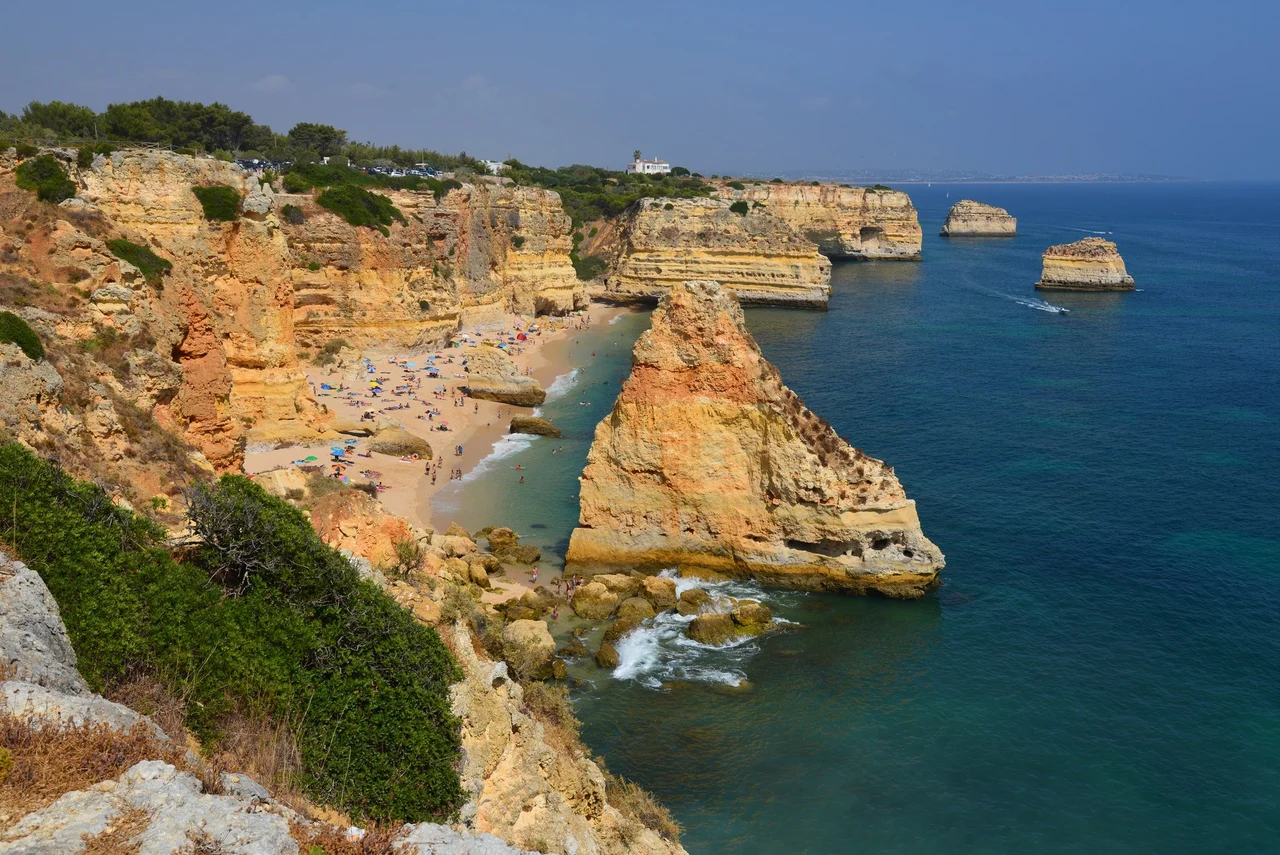
Quick Answer: The Algarve is not one market. The golden triangle, the central resort strip, the west and the east price differently, empty differently in winter and suit different buyers. Choosing the stretch matters more than choosing the property, and the flat 7.5% non-resident IMT applies across all of them.
One number frames the whole region. The Algarve is roughly 150 kilometres end to end, and a buyer who says “the Algarve” is describing a coastline longer than the distance from London to Birmingham. Nobody would shop for a house across that span without narrowing it first, and yet most Algarve searches begin exactly there.
Search demand agrees that the Algarve is the centre of the British market in Portugal: algarve properties buy runs at 2,400 a month in the UK, property for sale algarve at 1,900, and individual towns like Albufeira at 590 and Vilamoura and Tavira at 480 each.
What the portals ranking above this page cannot tell you is which of the four Algarves you are actually looking at. That is what decides whether you have bought a home or a summer.
The Four Algarves
| Stretch | Towns | Character | Winter |
|---|---|---|---|
| Golden triangle | Quinta do Lago, Vale do Lobo, Almancil | Golf resorts, large plots, gated developments | Quiet but staffed and open |
| Central strip | Albufeira, Vilamoura, Quarteira, Carvoeiro | Built around the season, apartments and resort villas | Thins sharply from November |
| West | Lagos, Praia da Luz, Burgau, Sagres | Dramatic coast, smaller towns, surf | Quiet, fewer services |
| East | Faro, Olhao, Tavira, Cabanas | Working towns, Ria Formosa, resident population | The mildest, and the most open |
| Inland | Silves, Monchique, Loule | Countryside, quintas, lowest prices | Cold nights, long drives |
The single most useful question a buyer can answer before viewing anything is which row they are in. It determines the price, the winter, the rental pattern and the resale market, and it is not a question the listing tells you.
What Each Stretch Costs
| Stretch | Price level, region average = 100 | What drives it |
|---|---|---|
| Golden triangle | Well above 100 | Plot size, golf frontage, gated security, international schools nearby |
| Central strip, front line | Above 100 | Sea view and walkable beach |
| Central strip, set back | Around 100 | The bulk of the apartment stock |
| West | Around 100, with sharp premiums on the coast | Scarcity rather than volume |
| East | Below 100 | Working towns, less foreign demand per square metre |
| Inland | Well below 100 | Land is not the constraint here, condition is |
Read those as relative. Take absolute figures per square metre from the INE series with a date, as set out in Portugal house prices, because published Algarve numbers age fast and portal averages mix asking prices with achieved ones.
Two Algarve-specific cautions on price. Sea view is priced steeply and defined loosely, so establish what is visible from which room in which season before paying for it. And plot size in the golden triangle is a large part of the number, which means the cost per square metre of building is a poor comparison tool there.
What You Pay on Top
| Cost | Basis | On a EUR 450,000 villa |
|---|---|---|
| IMT, non-resident | Flat 7.5% on residential property from 1 September 2026 | EUR 33,750 |
| Stamp duty | 0.8% of price | EUR 3,600 |
| Notary and registry | Fixed and variable | Low four figures |
| Legal fees | Commonly 1% to 1.5% | EUR 4,500 to EUR 6,750 |
| Total | Roughly 9% to 11% | About EUR 43,000 to EUR 50,000 |
The flat 7.5% rate applies while you are non-resident. A Portuguese tax resident buying the same villa moves onto a progressive scale that starts far lower, and a buyer who becomes resident within 24 months can reclaim the excess. The mechanics are in IMT for non-residents and the full cost of buying.
What It Costs to Hold
Algarve running costs sit above inland Portugal for physical rather than fiscal reasons: salt air shortens maintenance cycles, pools and gardens run year round, and condominium quotas on resort stock carry amenities inland buildings do not. Budget IMI at 0.3% to 0.45% of rateable value on top.
| Charge | Algarve character |
|---|---|
| IMI | 0.3% to 0.45% of rateable value, set by each municipality |
| AIMI | 0.7% above EUR 600,000 of taxable value per owner, which the golden triangle reaches routinely |
| Condominium | Resort developments with pools, gardens and security carry the highest budgets in Portugal |
| Pool and garden | A private pool is a recurring service contract, not a one-off |
| Salt-air maintenance | Front-line property needs more frequent external work than inland stock |
The condominium budget is the line to interrogate before buying into any resort development. Ask for the last two annual accounts and any approved works not yet billed. A pool refurbishment or a security contract renegotiation lands as a special assessment with a few months of notice.
The running-cost detail is in Portugal property running costs.
Letting It Out
Holiday letting in the Algarve requires an Alojamento Local registration, and the position is set municipality by municipality rather than regionally. Lagos, Albufeira, Faro, Loule and Tavira each apply their own policy, so a licence available on one side of a boundary can be closed 10 minutes down the road. The position varies by municipality. Several operate containment zones that restrict new registrations, so the answer for one street is not the answer for the next town.
Two rules follow. Verify the AL position for the specific address before the promissory contract, not after. And if a seller is marketing an existing registration as part of the value, confirm in writing whether it transfers on sale in that municipality, and what happens to the price if it does not.
Seasonality is the other half. Peak-week rates annualise into yields that do not survive contact with the void months, the management fee, IMI, the condominium charge and tax. The licensing framework is in the Alojamento Local guide.
New Build or Resale
The Algarve carries more new construction than anywhere in Portugal outside the Lisbon metro, which makes the new-versus-resale choice sharper here than the national picture suggests. New build arrives insulated, glazed and covered by a 5-year structural guarantee; resale arrives with a garden, a location and whatever the last owner did to it.
| New build and off plan | Resale | |
|---|---|---|
| Condition risk | Low on delivery, high on completion timing | Known, and surveyable |
| Payment | Staged against construction milestones | One deposit, one completion |
| Energy performance | Materially better, which shows in winter running costs | Older stock is usually poorly insulated |
| Location | Whatever land was available, often set back from the coast | The established front lines were built first |
| Price | A premium over comparable resale | Cheaper per square metre, more work |
| Resale market | Competing against the next phase of the same development | Competing against everything |
The completion risk is the one to price. An off-plan purchase in the Algarve is a commitment against a schedule, and schedules slip. Ask what happens to your staged payments if it does, and check that the answer is in the contract rather than in a conversation.
The energy point is underrated. A poorly insulated Algarve villa is cold and damp from December to February, and the heating cost is a real annual number rather than a footnote. New construction to current standards changes that materially, which is part of what the premium buys.
Off-plan mechanics are covered in the off-plan property guide.
Water, the Constraint Nobody Prices
The Algarve is the driest region in mainland Portugal and it supplies a summer population several times its winter one from reservoirs that depend on winter rain. In dry years the regional government imposes restrictions, and those restrictions reach property owners before they reach hotels.
| Water question | Why it matters to a buyer |
|---|---|
| Mains connection | Confirm it exists and is billed, not shared informally |
| Borehole or furo | Needs registration; an unregistered one is a liability |
| Condominium supply | Who pays for pool top-up in a restriction year |
| Garden and irrigation | The first thing restricted, and the largest domestic use |
| Pool | Filling and refilling can be limited in a drought year |
Two practical consequences. A large lawn on a large plot is a running cost that rises with every dry winter, which is one reason mature Mediterranean planting is worth more than turf here. And a rural property whose water comes from a borehole rather than the mains needs that borehole documented in the sale, with its registration and its yield, rather than described verbally at the viewing.
The regional answer under discussion is desalination on the central coast, and that is a decade-scale infrastructure question rather than something that changes a purchase in 2026. What changes a purchase is knowing which of the five rows above applies to the specific property.
What a year of ownership costs on a EUR 400,000 Algarve apartment
Acquisition on a EUR 400,000 apartment for a non-resident completing from 1 September 2026 runs to 7.5% IMT of EUR 30,000, 0.8% stamp duty of EUR 3,200, and roughly 1% to 1.5% in legal fees, so about EUR 38,000 before furniture. Annual holding then adds IMI at 0.3% to 0.45% of rateable value, condominium quotas that range from EUR 30 a month in a simple block to EUR 400 in a resort scheme with pool and gardens, buildings insurance, and management if the property stands empty between visits. AIMI at 0.7% applies only above EUR 600,000 of taxable value per owner, so most apartments at this level escape it. The number that surprises owners is not any single line but the total: roughly 10% of price to buy and a low four-figure sum every year to keep.
The Season, and What Actually Closes
The Algarve is not one calendar. The resort strip between Albufeira and Alvor empties between November and February, with restaurants shuttered and streets that feel abandoned to anyone who visited in August. The working towns behind it, Faro, Loule, Olhao, Tavira, Lagos, run all year because they have populations and economies that are not seasonal.
| Stretch | Winter reality |
|---|---|
| Central resort strip | Largely closed, quiet, some complexes near empty |
| Golden triangle | Quiet but alive, golf carries the shoulder months |
| Working towns | Fully open, this is where residents live |
| West coast | Very quiet, weather-exposed, a small surf population |
| Eastern Algarve | Open, with a substantial year-round foreign community |
This matters twice over. It decides whether a property is a home you could live in or a holiday asset you visit, and those are different purchases. And it decides the letting model: a unit on the closed strip has a short intense season and long dead months, while a unit in a working town can carry long-term tenants through winter and short lets in summer.
The single most useful thing a buyer can do here costs nothing: visit in January. Almost nobody does, and it is the visit that changes minds.
Why the eastern and western ends behave like different markets
Prices across the Algarve vary by more than a factor of 3 between the golden triangle and the inland fringe, and the gap has widened rather than closed over the past decade. The central resort strip between Albufeira and Alvor prices on beach proximity and empties from November to February. The golden triangle prices on plot size and permitted building volume, and its 5 golf courses extend demand into spring and autumn. The eastern Algarve around Tavira and Olhao prices on a working town with a resident population, which is why it holds long-term tenants through the winter months when the resort strip cannot. The west coast prices lowest of the four because it is exposed, cold in winter and furthest from Faro airport. In practice the same EUR 400,000 buys a small apartment near the beach on the central strip, a village house with land inland, or roughly a third of a golden triangle villa plot.
The A22, and How Far Things Actually Are
The Algarve reads as small on a map and drives long in practice. It is roughly 150 kilometres from Vila Real de Santo Antonio on the Spanish border to Sagres at the western tip, and the two ends are different countries in everything but administration.
| Route | Road | Practical time |
|---|---|---|
| Faro airport to the golden triangle | N125 or A22 | About 20 minutes |
| Faro airport to Albufeira | A22 | About 35 minutes |
| Faro airport to Lagos | A22 | About 55 minutes |
| Faro airport to Tavira | A22 | About 30 minutes |
| Faro airport to the west coast | A22 then N268 | Over 90 minutes |
| Lagos to Tavira, end to end | A22 | About 90 minutes |
The A22, the Via do Infante, is the toll motorway that runs the length of the region parallel to the free and much slower N125. Its tolls are electronic with no barriers, which regularly catches foreign-registered cars and hire vehicles: without a transponder or a registered card the charge is collected afterwards, and unpaid tolls accumulate penalties quietly.
For an owner this is a small recurring administrative task rather than a cost of consequence, and it belongs on the list of things to settle in the first month alongside the utilities. For a buyer comparing locations it is the reminder that airport proximity is a genuine amenity here, and that a west coast property is not a short hop from the arrivals hall whatever the map suggests.
Pros and Cons
The Algarve offers the deepest foreign resale market in Portugal, an airport within 90 minutes of almost anywhere in the region, and a winter climate that keeps a year-round population in the working towns. It also carries the highest running costs in the country and the most portal-saturated search results.
Advantages:
- The largest English-speaking community in Portugal, with services to match
- Direct flights from most UK and northern European airports, at least in season
- The mildest winters in mainland Portugal, particularly in the east
- A deep resale market in the central strip, which matters on exit
- Prices below comparable Mediterranean resort coasts
Disadvantages:
- Severe seasonality outside the eastern towns
- Faro’s winter flight schedule thins considerably
- Resort condominium budgets are the highest in the country
- AL containment restricts letting in several municipalities
- Prices in the central strip have risen faster than rents since 2020
Risks and Red Flags
Algarve regret has one dominant cause and it is seasonal. Buyers view in August, when the resort strip is at its loudest and fullest, and own in January, when much of it is shuttered. The rest follows from licences and running costs.
- Buying on a summer visit. The most common regret in the region, and a February trip settles it.
- Sea view sold loosely. Establish what is visible, from where, and whether a plot in front is developable.
- AL income assumed, not verified. Check the municipal position on the address before you commit.
- Condominium accounts not requested. Special assessments arrive with little notice and no ceiling.
- Treating the Algarve as one market. The east and the central strip are different products at similar prices.
Checklist before you offer:
- Confirm which of the four stretches the property is in, and visit in winter
- Get the AL position for that address in writing from the municipality
- Ask for the last two condominium accounts and any approved works
- Get the current VPT and last year’s IMI on the specific property
- Model the purchase at the non-resident rate, then again as a resident
Who Each Stretch Suits
Four Algarves means four different buyers, and matching the wrong buyer to the wrong stretch is the most expensive mistake made here. The variables that actually separate them are winter occupancy, distance to Faro airport, whether the town has a resident population, and how many weeks a year the owner intends to be present.
Year-round residents and retirees. The east. Tavira and Olhao keep their populations, services and schools through winter, and the climate is the mildest in mainland Portugal. Our Tavira guide covers the town.
Holiday-home buyers who will let. The central strip, subject to the AL position. The season is real, the management infrastructure exists, and the resale market is the deepest in the region. See Albufeira and Vilamoura.
Buyers at the top of the market. The golden triangle, and the comparison set is other European resort markets rather than the rest of Portugal.
Buyers who want quiet and coast. The west around Lagos, accepting fewer services out of season.
Buyers optimising for price. Inland, where condition rather than land is the constraint, and where a renovation budget and a licence queue both belong in the model.
The wider regional analysis, including yields and market history, is in the Algarve property guide.
Frequently Asked Questions
It depends on whether you want a year-round town or a season. The eastern Algarve around Tavira and Olhao keeps a resident population through winter. The central strip from Albufeira to Vilamoura is built around the season and thins considerably from November. The west beyond Lagos is quieter in both directions, and the golden triangle around Quinta do Lago and Vale do Lobo is a separate market priced on golf and privacy.
The spread inside the region is wider than between the Algarve and most of Portugal. The golden triangle sits at the top by a wide margin, the central resort strip next, then the western towns, with the eastern towns and inland Algarve lowest. Take absolute figures per square metre from the INE series with a date attached rather than from an article, because this is the number that goes stale fastest.
The same as anywhere in Portugal. As a non-resident buying residential property from 1 September 2026, a flat 7.5% IMT plus 0.8% stamp duty, plus notary, registry and legal fees, which together run to roughly 9% to 11% of the price. Becoming Portuguese tax resident within 24 months can open a refund of the excess IMT.
Yes, with an Alojamento Local registration, and the answer varies by municipality because several operate containment zones that restrict new licences. Verify the position for the specific address before you buy, not after. A property bought on a projected holiday-let income that cannot be licensed is a different investment from the one you modelled.
In the eastern towns, yes: Tavira and Olhao have resident populations, schools and services that run in February. In the central resort strip the seasonal swing is severe, with restaurants and services closing over winter and the population falling sharply. This is the single most common source of buyer regret in the region, and a February visit settles it.
The stretch around Quinta do Lago, Vale do Lobo and Almancil, between Faro and Vilamoura. It is a distinct market: large plots, golf resorts, gated developments and international schooling nearby, priced well above the rest of the Algarve. Buyers there are usually comparing it against other European resort markets rather than against the rest of Portugal.
Very, outside the eastern towns. Peak weeks carry rates that annualise into attractive-looking yields, which is why gross figures quoted on summer weeks are misleading. Model the year, including the void months, the management fee, IMI, condominium charges and tax, before treating a holiday let as an income plan.
Narrowing down the Algarve?
Tell us the budget and whether it is a home or a let. We shortlist by stretch and price the real cost of each.
Get a Portugal property shortlist
Tell us your budget and region (Lisbon, Algarve, Porto, Cascais). We reply within one business day with vetted options matched to your goals.